📆 Project Period | October – December, 2025 |
👤 CIN Visiting Researcher |
Project Summary
- Analysis of striping noise in the MetOp-SG Microwave Imager (MWI), in preparation for a potential scientific challenge on a problem common across satellite imaging.
- Noise modeling. Characterization of the MWI-13 V channel noise from pre-flight ground-test data, modeled as a Gaussian, two-component process – a white thermal floor and a long-memory 1/f flicker – with a highly reproducible power spectral density.
- Striping analysis. Quantification of striping (Striping Percentage 65%, Striping Ratio 1.39) and simulation-based study of its occurrence before and after two-point calibration: calibration mitigates but cannot remove striping, and calibration windows cannot reliably flag stripes in the Earth view.
- Noise generation and challenge dataset. Development and validation of a parametric Thermal+1/f and an empirical Look-Up Table (LUT) generator. A candidate challenge dataset is obtained by injecting synthetic noise into simulated MWI data, following the operational scanning geometry and calibration.
- Noise mitigation and challenge baseline. Benchmarking of Wiener filtering, PCA/EEMD, BM3D, and a Hybrid PCA/EEMD+BM3D, evaluated with a novel scene-adaptive score, the Striping-Preservation Index (SPI). The Hybrid achieved the highest median SPI (0.857) and is proposed as baseline; a Structure-Aware refinement raised the mean test score from 0.833 to 0.854, suggesting an improved approach.
Development Tools
- Data: MWI-13 V receiver ground-test acquisitions (provided by ESA Φ-Lab); EUMETSAT MWI Level-1B Test Data (available at https://user.eumetsat.int/news-events/news/eps-sg-microwave-imager-mwi-and-ice-cloud-imager-ici-l1-b-test-data).
- Noise analysis: first/second-order statistics, ADF and KPSS stationarity tests, ACF/PACF, ARFIMA fitting, Allan deviation and dynamic Allan deviation, Welch PSD estimation.
- Noise synthesis: frequency-domain spectral shaping with low-frequency cut-off (Thermal+1/f); empirical amplitude/phase look-up tables with Hann overlap-add (LUT).
- Destriping methods: windowed Wiener filter, PCA combined with Ensemble Empirical Mode Decomposition (PCA/EEMD), BM3D for correlated noise with known PSD, Hybrid PCA/EEMD+BM3D.
- Evaluation: Striping Index, PSNR, SSIM, Image Distortion index, one-sided Image Blurring index, and the scene-adaptive Striping-Preservation Index (SPI).
- Languages and frameworks: Python (NumPy, SciPy, Pandas, Matplotlib, statsmodels, allantools, bm3d, scikit-image, netCDF4, h5py, xarray).
Development Outputs
- Thesis: "Modelling, Generation and Mitigation of Striping Noise in the ESA MetOp-SG Microwave Imager – Satellite Destriping Scientific Challenge Preparation", Politecnico di Torino, July 2026.
- Noise generators: Thermal+1/f and LUT synthetic noise generators for MWI-13 V.
- Proposed challenge dataset pipeline: injection of synthetic noise onto MWI Level-1B orbits, following the operational scanning and calibration geometry; partitioning of orbits into 3 possible different scales; stratified train/test split based on patch scene complexity.
- Proposed challenge baseline and metric: testing of different destriping approaches and selection of the Hybrid PCA/EEMD+BM3D as baseline; design of an evaluation metric that considers both noise removal and signal preservation; development of a Structure-Aware Hybrid refinement as an advanced denoising approach.
- Code: source code for the noise generators, the challenge dataset pipeline, and the destriping methods, hosted in an internal ESA repository (access restricted, as it includes confidential instrument data).
Publications
M. Beghini, "Modelling, generation and mitigation of striping noise in the ESA MetOp-SG Microwave Imager: Satellite destriping scientific challenge preparation," M.S. thesis, Politecnico di Torino, Turin, Italy, 2026.
Project Description
Overview
MetOp Second Generation (MetOp-SG) is Europe's next-generation polar-orbiting meteorological satellite, developed by ESA and EUMETSAT. Among its instruments, the Microwave Imager (MWI), a conically scanning radiometer on the B-type satellites, measures the Earth's thermal emission between 18 and 183 GHz, supporting numerical weather prediction (NWP) with information on clouds, precipitation, and water vapor.
During pre-flight testing, all MWI channels were compliant except MWI-13 V (165.5 GHz), whose imagery showed striping. Its origin lies in the receiver electronics: alongside thermal noise, a low-frequency flicker (1/f) component makes successive scanlines, seconds apart, drift to different noise levels, which appear as stripes once the signal is folded into the two-dimensional swath. Since MWI brightness temperatures are directly assimilated into NWP models, such artifacts risk being mistaken for genuine geophysical features.
As this problem affects the whole class of microwave instruments, the project, carried out with the ESA Φ-Lab, lays the groundwork for a potential scientific challenge. The work pursues three objectives: characterizing and reproducing the instrument noise, preparing a realistic challenge dataset, and defining an evaluation metric and a performance baseline.
Instrument noise modeling
The noise was characterized from 11 ground-test acquisitions (~200 s each) recorded without the scan rotation, with the receiver pointing at fixed-temperature targets. The noise is approximately Gaussian, but its variance varies markedly between acquisitions recorded under identical conditions, and stationarity tests (ADF and KPSS) yield conflicting verdicts, a signature of long-range dependence, as confirmed by an ARFIMA fit (d ≈ 0.55). The Allan deviation shows white noise at short timescales and flicker noise beyond ~0.07 s, while the power spectral density (PSD) combines a flat thermal floor with a power-law rise at low frequencies (α ≈ −1.29), highly reproducible across acquisitions.
The noise is thus modeled as a Gaussian, two-component, long-memory process. Its total noise equivalent delta temperature is 0.964 K, 65% of which is due to flicker, placing the channel in the severe-striping regime. Its amplitude scales with the system temperature, linearly for the thermal component and to first order for the flicker one, so the laboratory characterization can be transferred to any scene temperature.
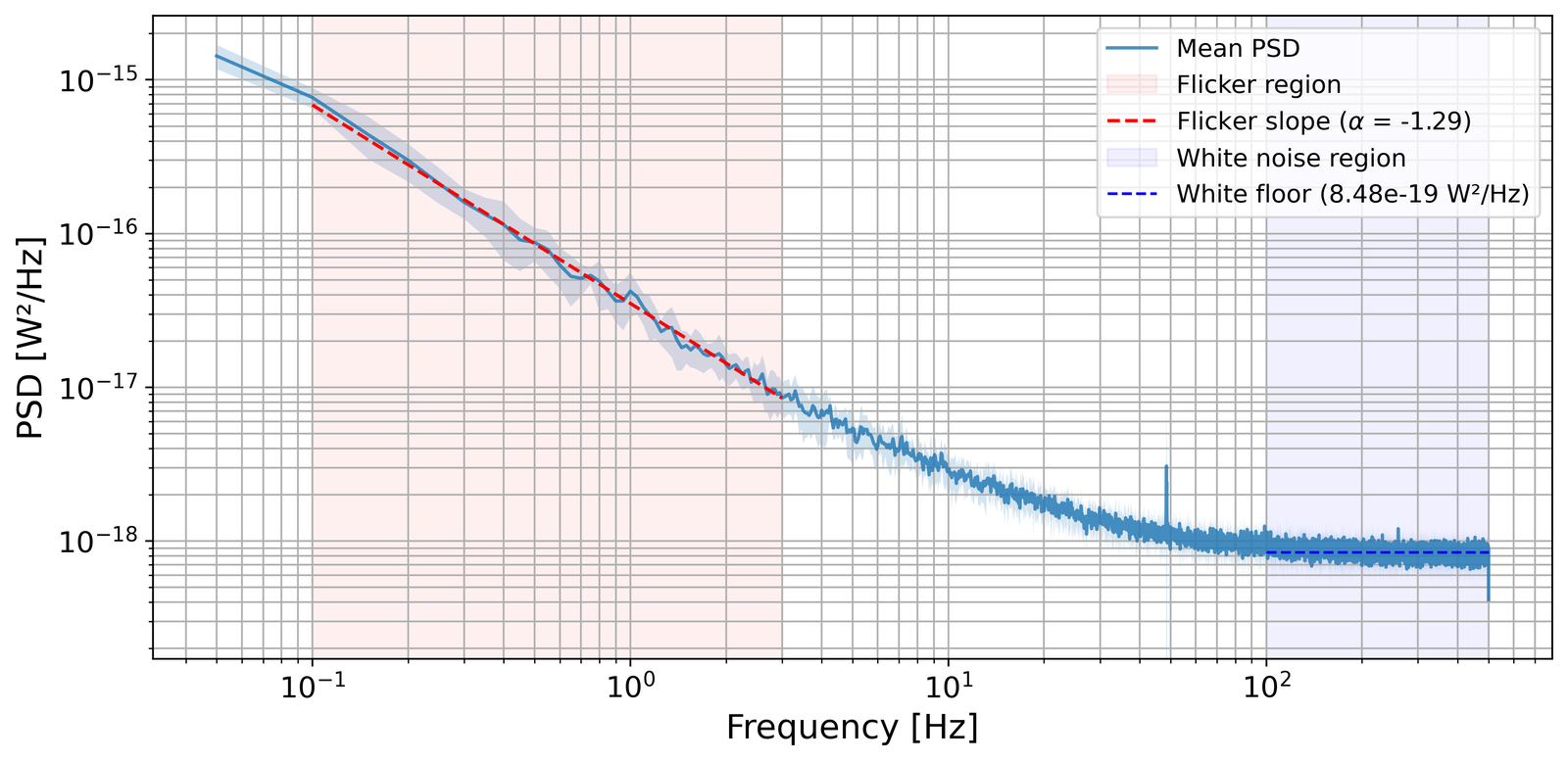
Mean PSD of the MWI-13 V ground-test noise, with variability band and fitted slopes: a flat thermal floor and a 1/f-like rise at low frequencies.
Striping and calibration
To study how striping behaves in orbit, the full acquisition chain was reproduced: the noise was folded into the scan geometry (cold sky, on-board hot target, and Earth view), rescaled to each segment's temperature, and processed by two-point radiometric calibration. Over one simulated orbit, calibration raises the fraction of clean scanlines from 53% to 81% (1 K threshold) and reduces full-scanline stripes from 25% to below 3%, but localized partial stripes persist.
A quality flag based on the calibration targets, reliable before calibration, becomes uninformative after it, since the residual striping comes from flicker excursions during the Earth view, which the targets never observe. Striping must therefore be addressed at the image level.
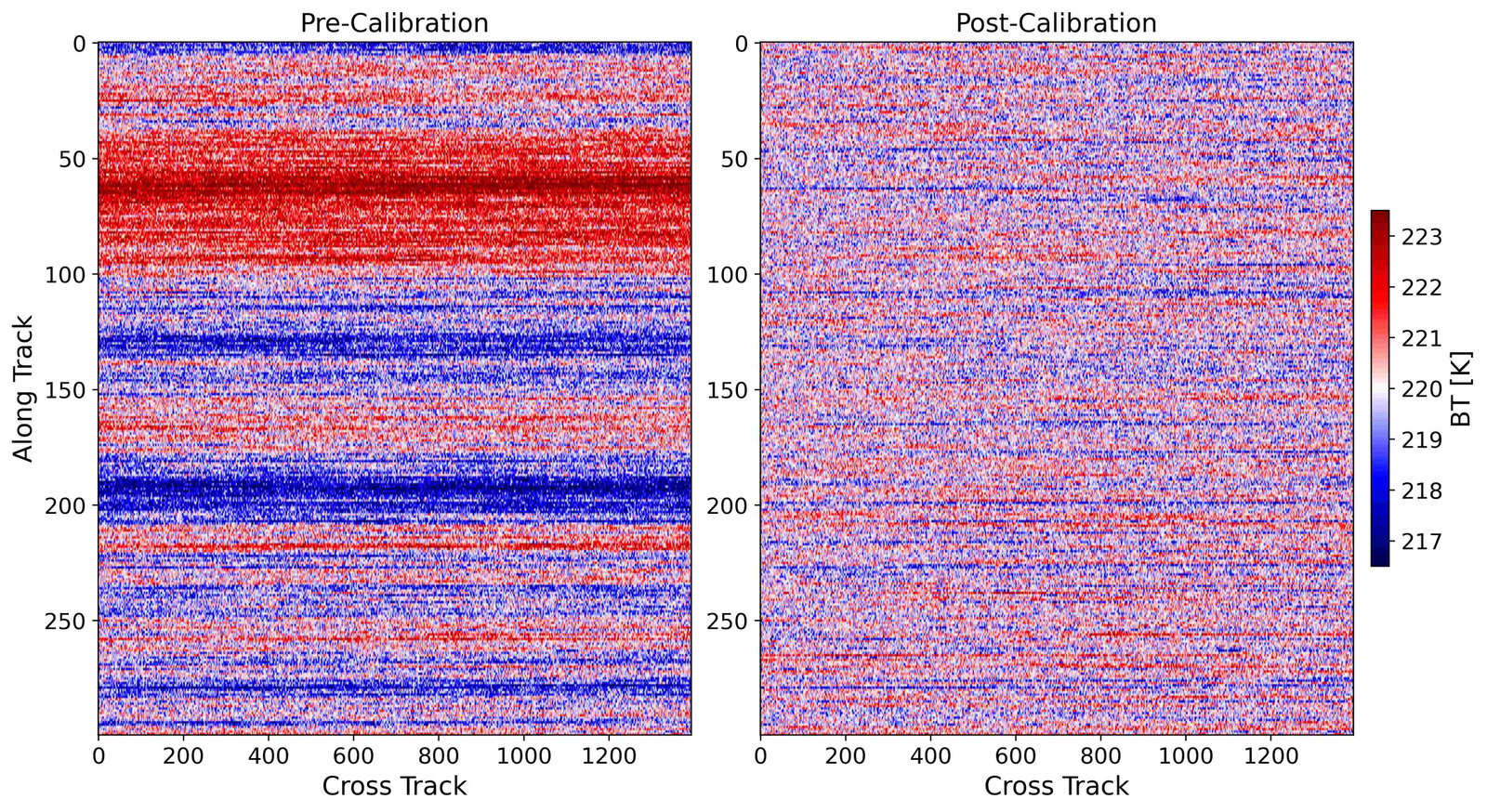
Simulated MWI-13 V swath over a constant 220 K scene, before (left) and after (right) two-point calibration: broad bands are removed, finer stripes remain.
Synthetic noise generation
Two generators were developed to produce realistic noise for the challenge dataset. The parametric Thermal+1/f model, an implementation of the simulation method of Yang et al. (IEEE TGRS, 2022) adapted to MWI-13 V, builds the noise as white Gaussian noise plus a spectrally shaped flicker component, with a low-frequency cut-off (0.0025 Hz) calibrated to avoid injecting excessive low-frequency energy. The empirical LUT model, originally developed at ESA, stores the amplitude and phase distributions for each frequency bin extracted from the laboratory data and synthesizes noise via random sampling and overlap-add. In this work, its implementation was validated, and its window length was set to 200 s via cross-validation.
Both generators reproduce the observed distribution, PSD, Allan deviation, and striping metrics with biases below 2%; the LUT model, which best reproduces the spatial appearance of striping, was adopted for the dataset.
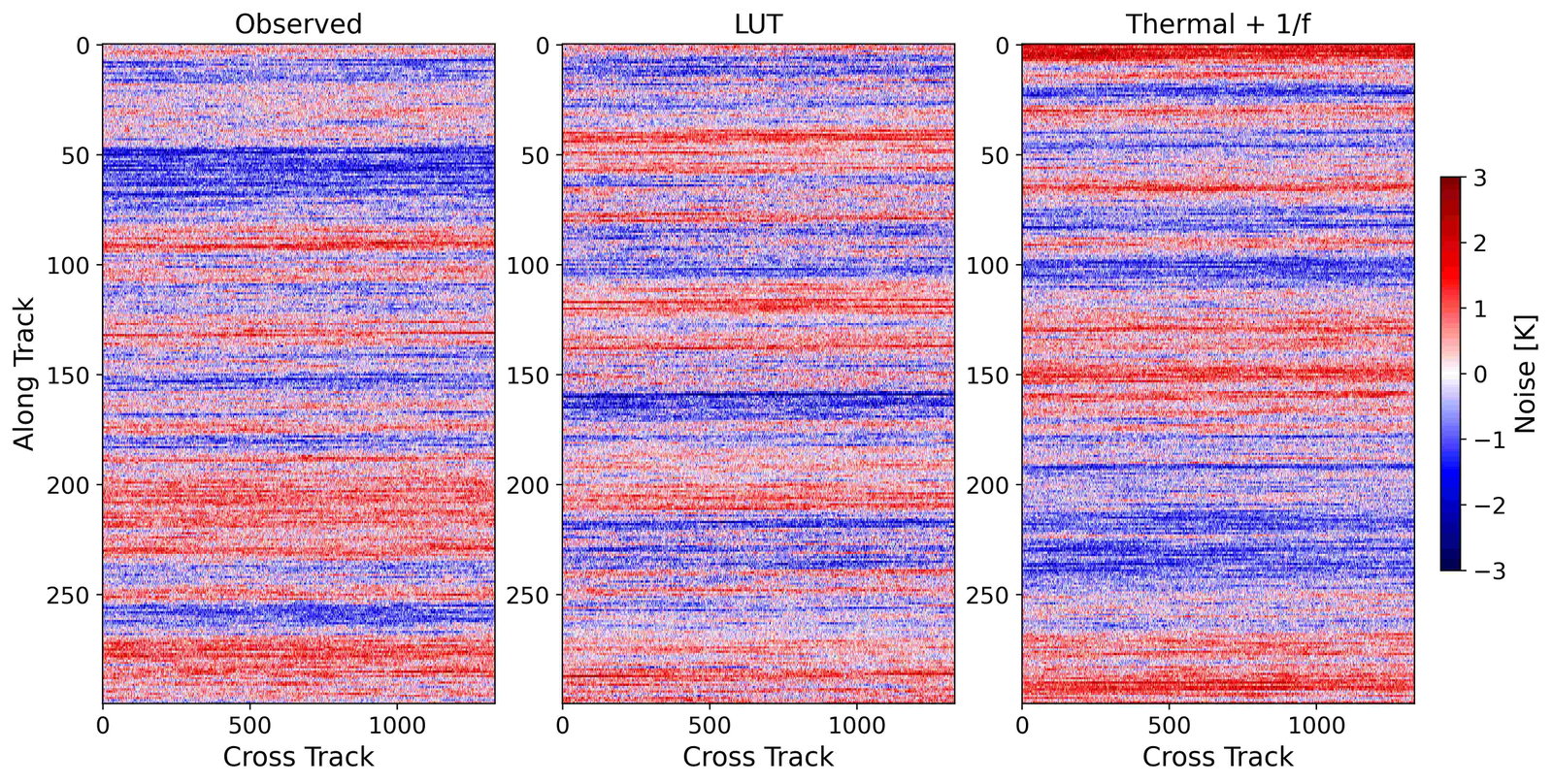
Swath obtained by folding the observed noise (left), LUT noise (center), and Thermal+1/f noise (right) into the MWI scan geometry.
Challenge dataset
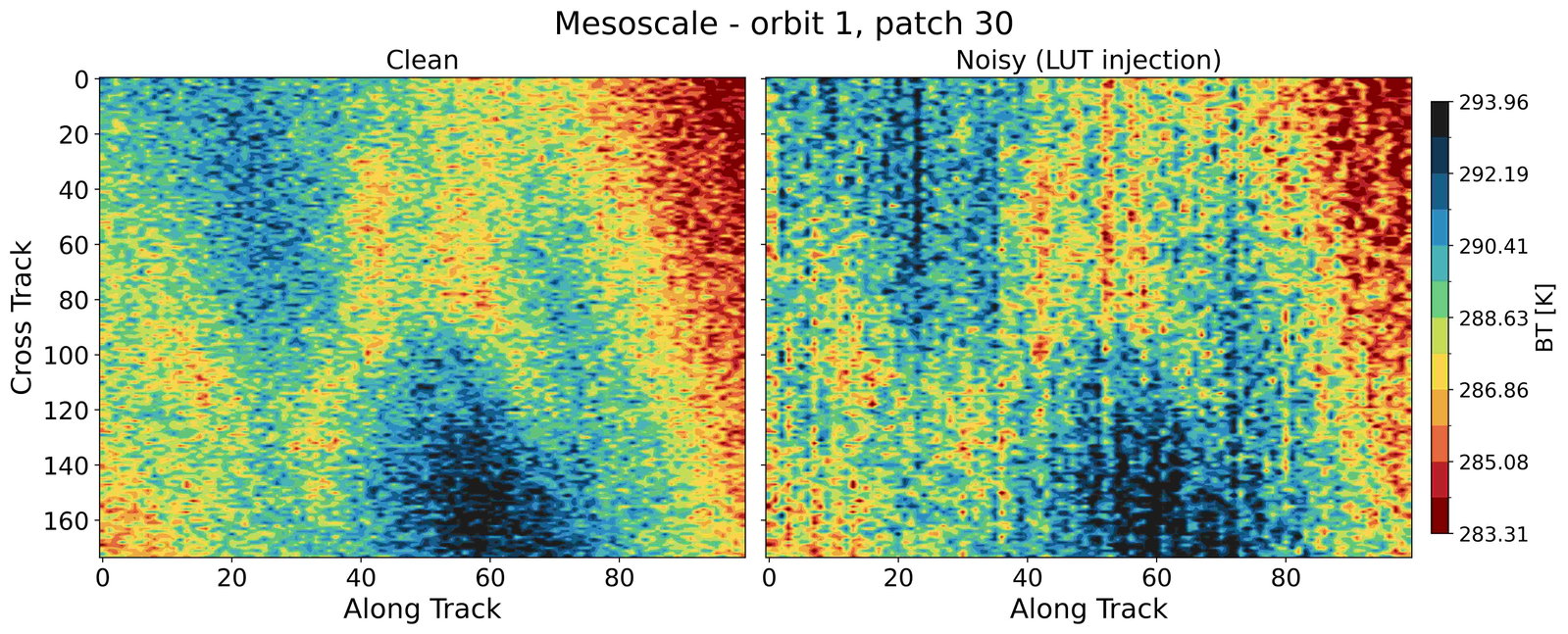
As MetOp-SG B1 is scheduled for launch only by the end of 2026, the dataset was built from the EUMETSAT MWI Level-1B Test Data: three simulated orbits spanning conditions from the African desert to Antarctic surfaces. The LUT noise was injected by reproducing the full acquisition chain (synthesis, resampling to the operational rate, scan folding, temperature scaling, and calibration), with an independent noise realization per orbit. Each orbit was then partitioned into local, mesoscale, and synoptic patches, with sizes chosen to account for the strong anisotropy between along-track (~8.9 km) and cross-track (~1.2 km) sampling. Knowing both the clean scene and the injected noise is what makes an objective open competition possible.
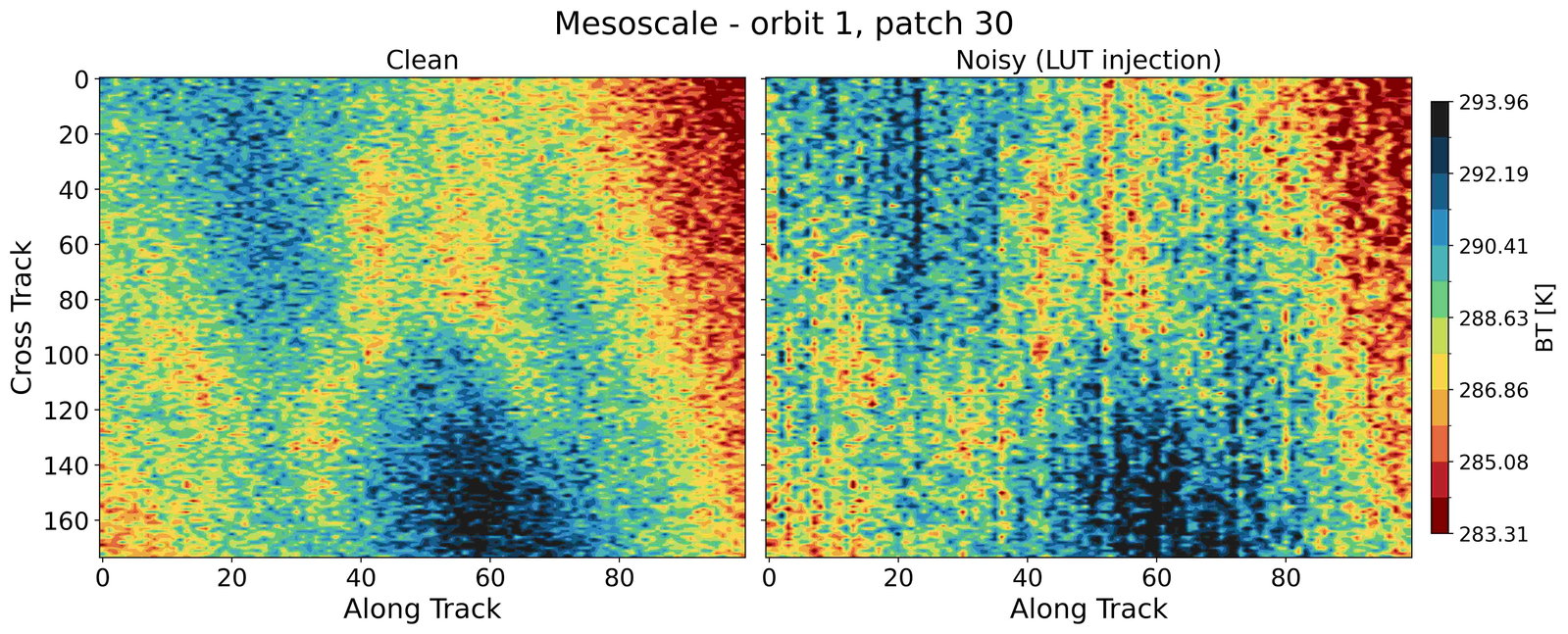
Example of a mesoscale challenge patch: clean Level-1B scene (left) and the same scene after LUT noise injection (right).
Destriping methods and evaluation
Three methods were compared: a Wiener filter exploiting the measured noise PSD; PCA/EEMD, the operational benchmark for heritage instruments such as ATMS and GMI; and BM3D, a state-of-the-art denoiser for correlated noise with known PSD. Since PCA/EEMD and BM3D fail on complementary aspects, a Hybrid PCA/EEMD+BM3D was introduced, applying both in mild configurations: the first stage removes the dominant stripe mode, the second refines the residual.
No single existing metric proved sufficient: the Striping Index misses non-directional structure loss, PSNR rewards oversmoothing, and SSIM barely separates the methods. The metrics were therefore combined, along with a modified one-sided Image Blurring index, into the Striping-Preservation Index (SPI), a scene-adaptive score that weights striping removal more heavily on uniform scenes and structure preservation more heavily on textured ones, reflecting the dual goal of the challenge.
Results
- Wiener filter: even with precise PSD knowledge, it distorts the scene while leaving the striping, because stripes and scene structure share the same low-frequency band. This negative result shows that spatial structure, not spectral characterization alone, must be exploited.
- PCA/EEMD: effective on favorable scenes, but strongly scene-dependent: on structured scenes, it removes genuine geophysical features together with the stripes.
- BM3D: consistent, but systematically oversmooths fine cross-track details, which only the Image Blurring index exposes.
- Hybrid PCA/EEMD+BM3D: highest median SPI (0.857) with a tight spread across 1056 mesoscale patches, making it the most robust method. It is among the top two methods across 88% of patches, performing comparably on easy scenes and decisively outperforming on hard ones.
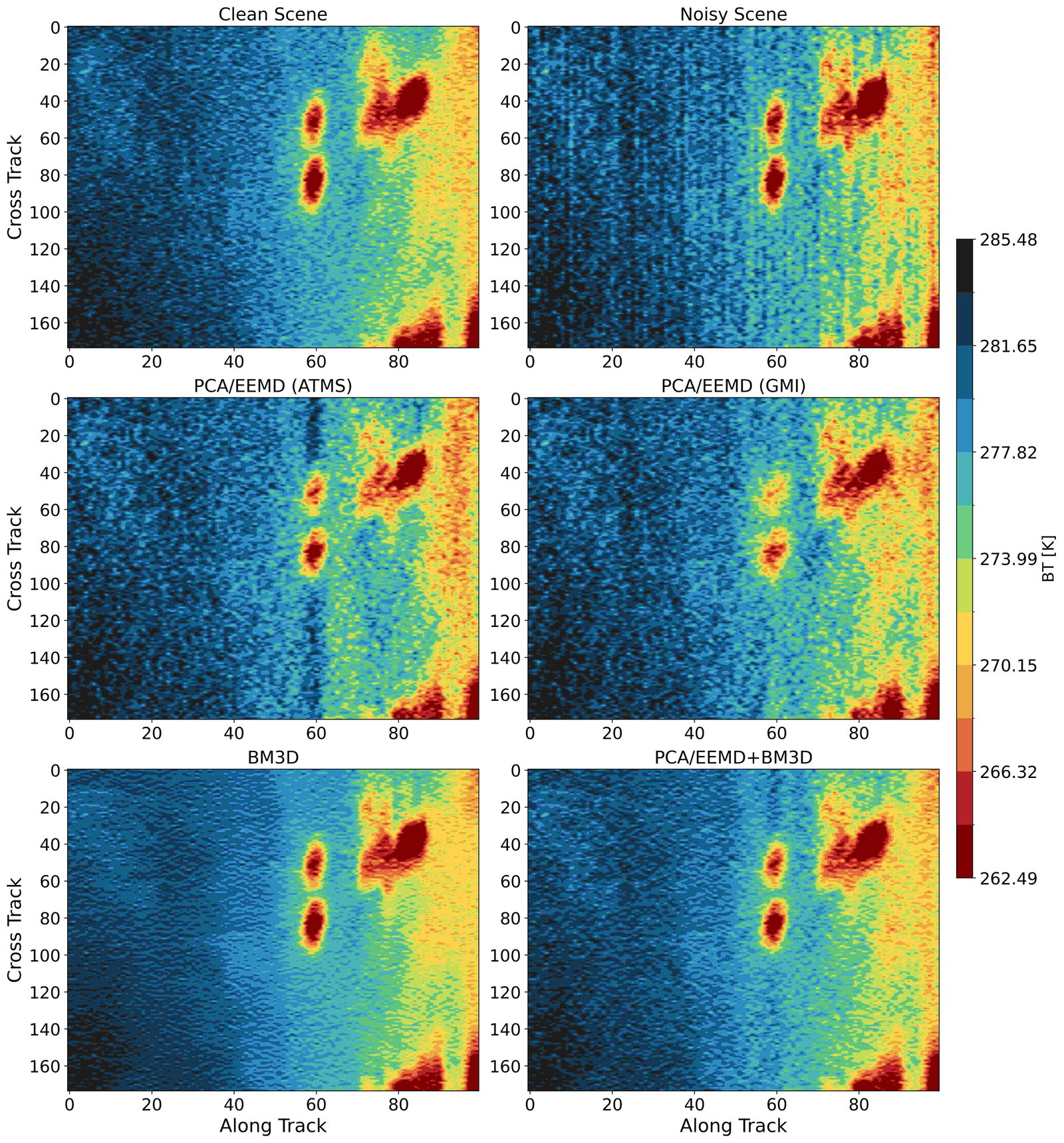
Comparison of the destriping methods on a mesoscale patch: clean and noisy scenes (top), PCA/EEMD in its two configurations (middle), BM3D and the Hybrid (bottom).
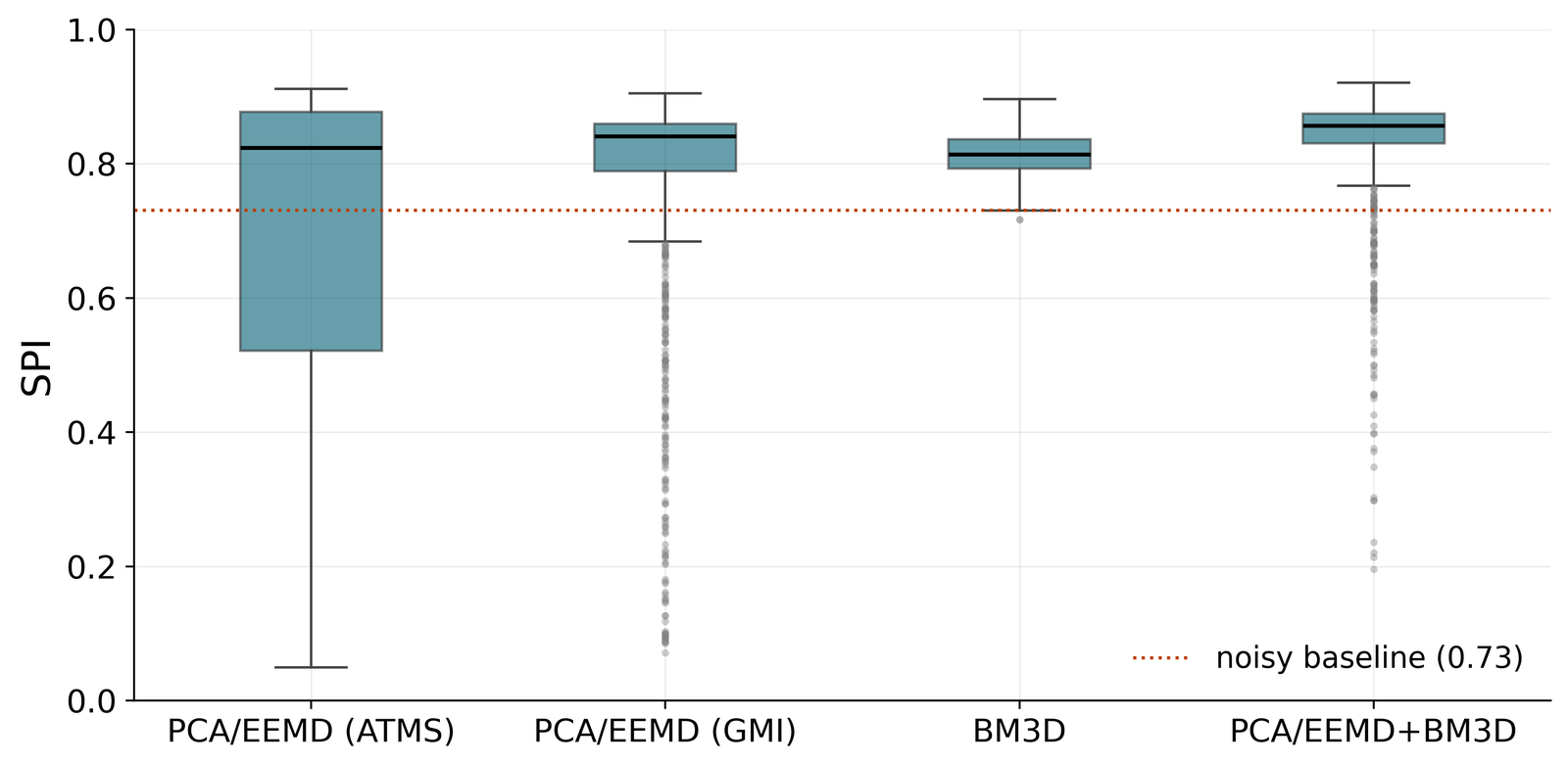
SPI distribution over three orbits (1056 mesoscale patches): the Hybrid shows the highest median and a tight spread.
The Hybrid's only real weakness lies in highly structured scenes, where the PCA stage removes genuine features along with the stripes. A no-reference structure indicator, computed from the noisy data alone, identifies these scenes reliably (Spearman ρ = 0.91 with the true scene complexity). The resulting Structure-Aware Hybrid routes them to BM3D alone, raising the mean test SPI from 0.833 to 0.854 with comparable runtime, and shows that destriping can adapt to each scene without access to the clean image.
Scientific and Operational Impact
This work delivers the core components for an open MWI destriping challenge: a validated noise model, realistic noise generators, a noise-injected dataset in the official Level-1B format, a scene-adaptive metric, and a non-learned baseline. The latter provides a fair basis for assessing whether machine-learning methods, which require exactly this kind of labeled dataset, offer a genuine advantage. Beyond the challenge, the analysis shows that calibration alone cannot remove MWI striping, that calibration targets cannot flag it after calibration, and that the established PCA/EEMD benchmark fails on structured scenes, a limitation mitigated by the Hybrid and its adaptive routing. As striping affects the whole class of microwave radiometers, these results extend beyond MWI.
Future Developments
Once the challenge is officially confirmed and its timeline defined, the following steps will be required for its finalization:
- Enlarge the proposed challenge dataset and extend it to real MWI observations once MetOp-SG B1 is in orbit.
- Validate the SPI more systematically before fixing it as the official challenge metric.
- Test the methods on other patch sizes and varying noise levels.
- Finalize the challenge specification (dataset, metric, and baseline) together with ESA.
Further research directions include:
- Extending the noise characterization with longer ground-test acquisitions, as also recommended by the MWI Science Advisory Group for future missions.
- Exploiting multispectral information across MWI channels to separate the geophysical signal from spectrally uncorrelated flicker noise.
- Reducing the computational cost of the BM3D stage for large-scale and operational use.