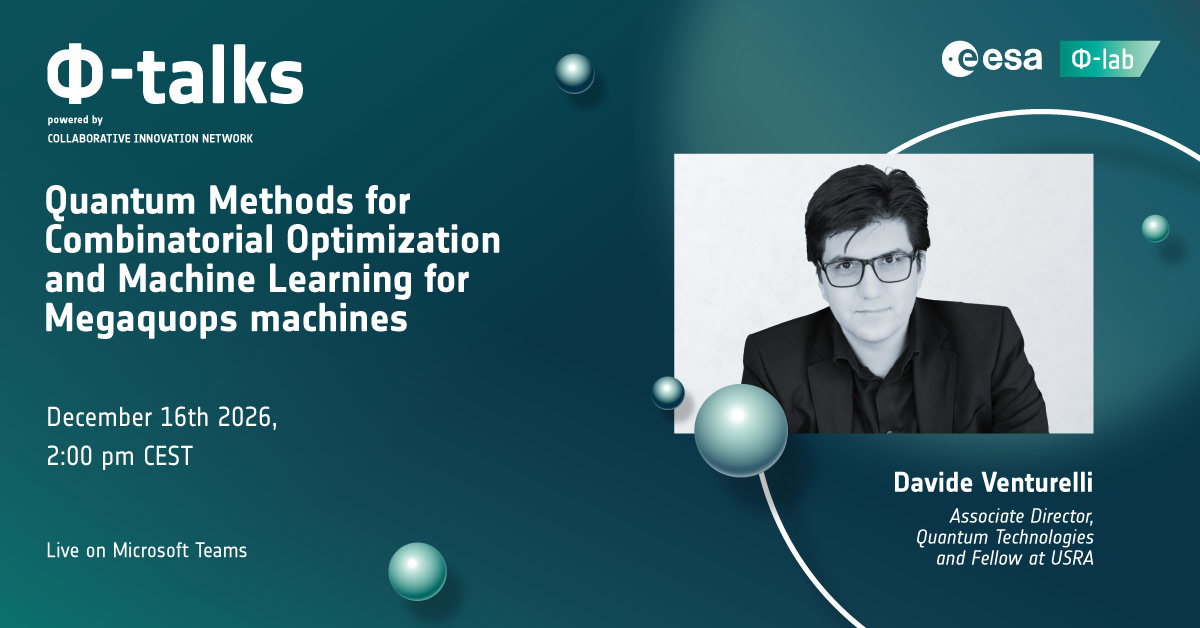
December 16, 2026 | 2:00 PM CEST
Live on Microsoft Teams.
On December 16, the ESA Φ-Lab Collaborative Innovation Network will host a new Φ-talk. Details are below.
Meet the speaker
Dr. Davide Venturelli serves as USRA Associate Director for Quantum and as a Distinguished Fellow at the USRA Research Institute for Advanced Computer Science (RIACS). A founding member of the NASA Quantum AI Laboratory (QuAIL) in Silicon Valley, he has worked there since 2012 on research projects spanning quantum computing applications and the hardware-software co-design of quantum systems. Most recently, he is supporting NASA’s AI team at the Office of Data Science and Informatics (ODSI). Since 2021, he has been a co-lead of the Applications and Use-Cases group at the National Quantum Initiative Superconducting Quantum Materials and Systems (SQMS) Center at Fermi National Laboratory in the Chicago area. He holds a Master’s in Physics from École Normale Supérieure de Lyon and a Ph.D. degree from the University of Grenoble in Nanophysics and from the International School for Advanced Studies (SISSA) in Quantum Simulations.
Talk abstract
The next generation of quantum processors will carry 100 to 1000 qubits that are partially, not perfectly, protected from noise. Such machines reward heuristics designed to live with noise and, in some cases, to exploit it. This talk first reviews where the field stands in 2026-27: semi-protected qubits, multi-core and networked architectures, warm-start heuristics moving from simulation onto hardware, and frontier AI entering the research loop. It then presents methods developed by the USRA Research Institute for Advanced Computer Science and its collaborators, several of which have been implemented and tested on a variety of superconducting hardware (for example, Noise-Directed Adaptive Remapping). These hybrid heuristics push the envelope of what is possible in combinatorial optimization, targeting regimes where classical methods are furthest from optimal (impacting space applications such as mission planning, observation scheduling across satellite constellations, and custody recovery in space domain awareness).
Register Here!